

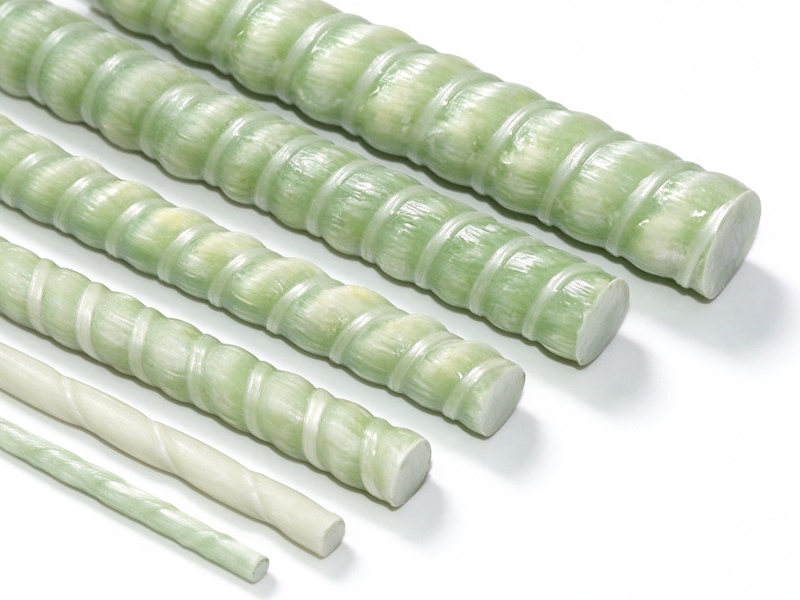
Fiberglass Rebar
Pultruded fiberglass rebar in 6 mm to 32 mm diameters, non-conductive, non-magnetic and corrosion resistant for bridge decks, tunnel linings and slope support....
Product Overview
Fiberglass rebar is a composite bar with a ribbed surface, made from fiberglass and resin by pultrusion. It is strong, light, corrosion resistant, electrically non-conductive and non-magnetic, and it is a new material for replacing steel rebar in construction. As a substitute for steel it markedly extends the service life of a structure in suitable projects, and it suits concrete structures in coastal and highly corrosive environments in particular. Fiberglass rebar weighs about a quarter of the same volume of steel, which makes transport and installation easier, and because it does not rust it avoids the expansion and cracking that occurs when the concrete cover over steel is insufficient. Its use in bridges, tunnels and slopes is growing, and it is an important new material for infrastructure construction.
The rib profile is well designed and bonds well to concrete, so structural loads are transferred effectively and the member acts as a whole. A full range of specifications is available and lengths can be customized, with bent sections and other accessories supplied to project requirements; installation is straightforward, which makes the bar a practical choice for structural strengthening and new build work.
Technical Specifications
Common diameters range from 6 mm to 32 mm, and the surface ribs improve the bond with concrete. Tensile strength is far higher than that of ordinary steel rebar and density is about a quarter that of steel; cut-to-length supply is available to project requirements, with bent sections and other accessories. The bar is non-conductive and non-magnetic, which makes it safer in special structural locations, and its mechanical properties are stable enough to meet design requirements for strength and ductility.
Diameter accuracy is high and the ribs are regular, so the bar bonds tightly to concrete. Cut-to-length bars in different diameters and lengths are available, and bent sections and other shaped parts can be produced to the design so that site work is easier.
Production and Quality
Fiberglass rebar is formed continuously on pultrusion lines with tight control of fiber content and degree of cure, and the ribbed surface is regular and even. Appearance is checked and mechanical properties are sampled and tested batch by batch before dispatch, so that strength, diameter and bond performance meet the design. Test data are recorded by batch and an inspection report is supplied. Custom specifications are available to project requirements, and sample inspection and performance testing are supported so that the product meets the design and the conditions of use.
The company can supply in volume and meet the quantities required by large projects. Products are packed in bundles with clear markings for easy transport and site control, which gives customers a dependable supply of engineering material.
Applications
Fiberglass rebar is widely used in bridge decks, tunnel linings, slope support, retaining walls, basements and wharves, and it suits coastal and highly corrosive environments in particular; it can also be used where electromagnetic performance matters. Performance stays stable over long service in corrosive conditions, service life is markedly extended and maintenance cost is reduced. Hebei Zhengche Trading Co., Ltd. provides rebar selection, customization and technical advice as a dependable substitute-rebar solution for construction projects.
In infrastructure construction and structural strengthening work, the corrosion resistance and high strength of fiberglass rebar make it an important material for improving structural durability. With consistent product quality and complete service, the company continues to supply quality fiberglass rebar to construction projects.