

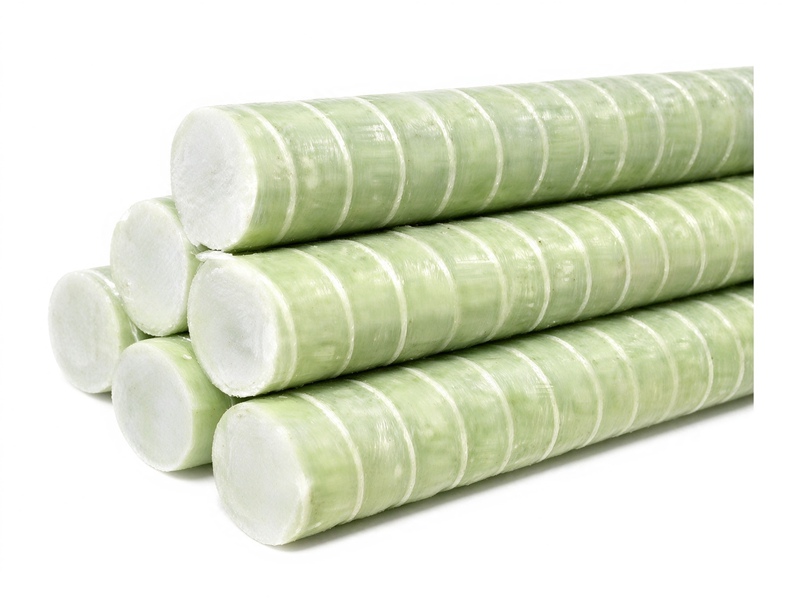
Fiberglass Rebar
Pultruded fiberglass rebar from 6 mm to 32 mm in diameter, corrosion resistant and non-conductive for bridge decks, tunnel linings and slope support....
Product Overview
Fiberglass rebar is a composite bar with a ribbed surface, produced from fiberglass and resin by pultrusion. It is strong, light, corrosion resistant, electrically non-conductive and non-magnetic, and it can replace steel rebar in concrete structures, markedly extending service life in suitable projects, particularly coastal and highly corrosive environments. Bars can be supplied cut to length to the design, which makes site work easier and gives projects a dependable reinforcement material.
Fiberglass rebar is a newer type of reinforcement that is now widely used in civil engineering. Tensile strength is high and density is low, so handling and transport are simple. The ribs bond well to concrete and transfer structural loads effectively. The bar resists chloride attack, avoiding the corrosion and expansion that affects steel, which improves the durability of concrete structures. A full range of diameters is available, so the right bar can be chosen for each part of the structure.
Technical Specifications
Common diameters run from 6 mm to 32 mm, the surface ribs are regular, and lengths are cut to project order. Tensile strength is high and density is about one quarter that of steel; bent sections and other accessories can be supplied to suit the design. Diameter accuracy is high and bond performance is good, with mechanical properties stable enough to meet structural design requirements. Bars can be produced in batches to project needs, with full documentation for design selection.
Specifications are set by the project: diameter, length and surface form can be adjusted to the design. Different resin systems can be used according to the position of the bar, meeting requirements for alkali and temperature resistance. Straightness is good and the ribs are even, so the bar bonds tightly to concrete and is easy to install; batch production to order is available. Standard cut lengths reduce site fabrication and improve construction efficiency.
Production and Quality
Process control is strict, with stable fiber content and degree of cure and an even, regular rib profile. Appearance and mechanical properties are checked batch by batch before dispatch so that strength and bond performance meet the design. Test data are filed and a quality inspection report can be supplied with the goods for customer acceptance. Production is managed to a defined procedure, which keeps quality consistent across batches.
Quality control covers raw material inspection, in-process control and finished product inspection, and passed bars are packed and shipped by size. Samples are kept and tested by batch so that quality can be traced. The surface is smooth and free of burrs, which helps site work, and complete quality documentation supports the customer's project. Packing is standardised and protects the bars in transit, so they arrive in good condition for use on site.
Applications
Fiberglass rebar is widely used in bridge decks, tunnel linings, slope support, retaining walls, basements and similar structural elements. It suits marine and highly corrosive environments in particular, markedly improving durability and reducing maintenance cost. Results in coastal projects are good, and the bar is an important material for extending the service life of infrastructure. It is easy to place and works with concrete to form durable members.
Bars can be used in crash barriers, wharf structures, wastewater treatment structures and other parts prone to corrosion, avoiding the structural damage caused by rusting steel. Being non-conductive and non-magnetic, the bar suits subways, substations and other projects sensitive to electromagnetic conditions, giving a safe reinforcement solution for special locations. Bars are made to order to meet the design requirements of different structural parts, so the range of use is wide.