

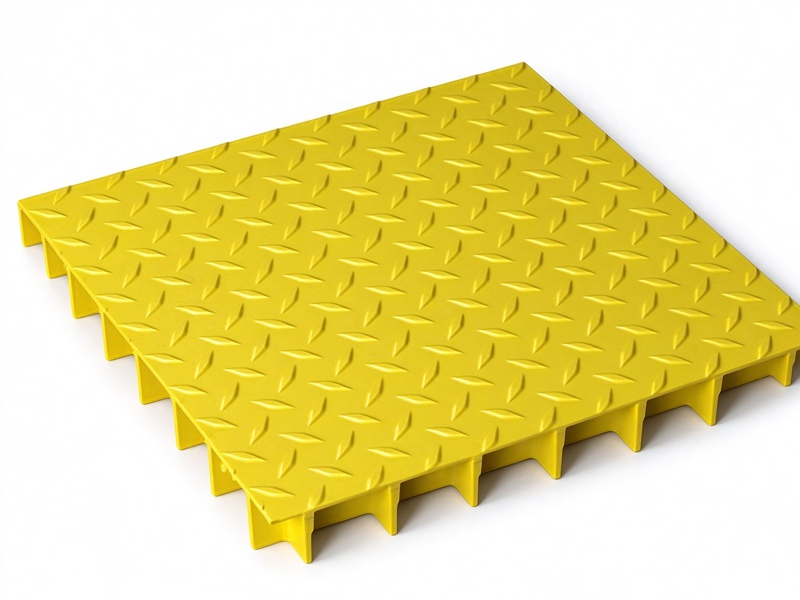
FRP Grating
Molded FRP grating with 25 mm to 50 mm mesh and panel thickness, slip resistant and corrosion resistant for chemical platforms, walkways and trench covers....
Product Overview
FRP grating is a grid-shaped composite panel made from fiberglass and unsaturated polyester resin by compression molding. It is strong, light and corrosion resistant. The regular grid on the surface combines load bearing with slip resistance, which makes the panel a common material for industrial platforms and walkways. Compared with steel grating, FRP grating does not rust in acid, alkaline or damp conditions and needs no periodic protective coating, so it lasts longer and costs less to maintain overall; it suits highly corrosive locations such as chemical plants and wastewater treatment works in particular. The panel can be cut on site and installed quickly with support beams and fixing clips.
FRP grating uses fiberglass as reinforcement and resin as matrix and is made by compression molding. The panel is molded in one piece with a dense structure and an even grid, so load capacity is high and the surface is slip resistant. It is light and strong, which makes handling and installation easier and reduces the load on the supporting structure. The panel is non-conductive and non-magnetic with good insulation, which makes it safer in electrical work areas. Standard colours are yellow, grey and green, sizes can be customized to the project, and the panel is a common safety platform material in modern industrial plants.
Technical Specifications
Common grid spacings are 25 mm, 38 mm and 50 mm, common panel thicknesses are 25 mm, 38 mm and 50 mm, and panels can be cut to project requirements. Different resin systems can be selected for the service environment to give flame retardancy and corrosion resistance, and standard colours are yellow, grey and green. Load capacity depends on panel thickness, grid and support spacing, so the specification should be chosen from the service load and the support conditions, with support beams spaced to the design, to keep the platform safe in use.
FRP grating is specified mainly by grid size, panel thickness and overall size; common specifications cover the 25 mm to 50 mm grid range with panel thickness from 25 mm to 50 mm. Plain and slip-resistant surfaces are available, and the panel can be machined into shaped parts to fit equipment surrounds and similar details. Mechanical properties are stable, impact and bending resistance meet the needs of foot traffic and equipment support, and the surface is flat and smooth for easy cleaning; sizes can be customized to the project, which makes the panel a dependable platform material.
Production and Quality
In production the resin formulation, fiber content and molding process are tightly controlled, and the panel has a smooth surface and a dense structure with no bubbles or delamination. Appearance and dimensions are checked batch by batch and mechanical properties are sampled and tested by batch to confirm that load capacity meets the requirement. Test data are recorded and kept on file, and an inspection report can be supplied with the goods for customer acceptance. Production is managed to written procedures, with checks from raw material to finished product, so that quality is consistent across batches.
FRP grating is produced to strict process standards; after molding each panel is trimmed and inspected so that the grid is regular and the dimensions are accurate. Every panel is checked for surface quality before dispatch, with tight limits on cracks, flash and similar defects, so overall quality is consistent. Samples are kept and tested by batch, quality is traceable, and the customer is given dependable quality assurance. Packaging is to standard, care is taken against impact in transit, and the panels arrive in good condition ready for installation.
Applications
FRP grating is widely used in petrochemical, power, metallurgy and environmental protection plants for operating platforms, maintenance walkways, trench covers and stair treads. It suits damp and corrosive locations in particular, where it lasts long and is easy to maintain. It is also used in marine engineering and coastal facilities, where its resistance to salt spray makes it a practical replacement for steel grating. Installation is simple, the panel can be cut and adjusted on site to fit different details, and performance stays stable over long service.
FRP grating is widely used in wastewater treatment plants, chemical works and electroplating shops as platform decking and walkway material; its corrosion resistance and slip resistance help keep personnel safe at work. It is also used in hygiene-sensitive industries such as food processing and pharmaceuticals, where the surface is easy to clean and does not support mould growth. Good insulation makes it safe in electrical work areas, and it is a material widely chosen for safety facilities in industrial plants.