

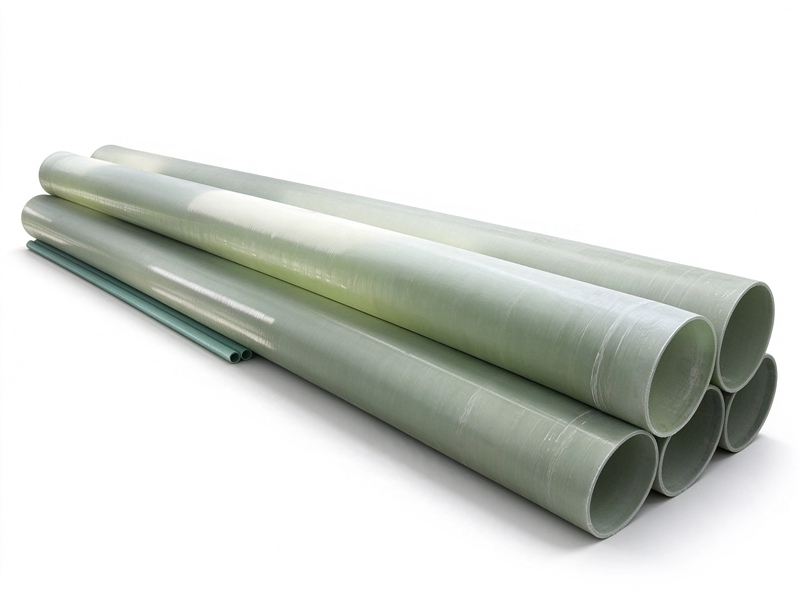
FRP Pipe for Corrosive Media
Wound FRP pipe with the resin system selected for the medium, resisting soil and seawater corrosion in buried networks and coastal projects....
Product Overview
FRP pipe is wound from fiberglass and resin, and the wall is built to a structure designed for the service pressure, so the pipe has high strength and good sealing. Its weight is a fraction of that of a steel pipe of the same size, which eases transport, lifting and installation and lowers overall project cost. The pipe is a good insulator and non-magnetic, so it can be used where those properties are needed, and it serves water supply and drainage, chemical and power systems. Fittings are complete, jointing methods are flexible and installation is fast.
FRP pipe is one of the main product types in the FRP range. The resin system can be selected for the medium carried and the service conditions, so requirements for acid and alkali resistance, temperature resistance and flame retardancy can all be met. Sizes are complete and jointing is flexible, with socket and flanged connections, so installation is convenient. The pipe resists soil and seawater corrosion and offers clear advantages in buried networks and coastal projects. The smooth bore resists scaling, transfer efficiency stays stable in long service and maintenance work is limited.
Technical Specifications
Common diameters cover a wide range of standard sizes, wall thickness is designed for the working pressure, and lengths are cut to project requirements. Working temperature is limited by the temperature rating of the resin, so the medium temperature should be matched to the resin system at the selection stage. Socket (bell-and-spigot) joints and flanged joints are the usual connection forms and matching fittings are supplied; the pipe structure and wall thickness can be designed to suit the system. Pressure classes can be provided to project requirements for different transfer systems.
Pipes are graded by service pressure, and the wall consists of a filament wound layer and a surface resin layer, a sound structure of reliable strength. A smooth bore and low roughness keep hydraulic friction low and cut pumping energy. Custom diameters, lengths and wall thicknesses are available to project requirements. Specification marking is clear for site control, and the complete set of fittings ensures reliable joints and quick installation.
Production and Quality
Production follows strict process standards, with winding tension, resin content and degree of cure under control, giving a dense wall and stable performance. Each pipe is inspected for appearance and measured before dispatch, and hydrostatic pressure and mechanical properties are sampled by batch to confirm fitness for use. Data are recorded and kept on file, and inspection reports can be supplied with the shipment for customer acceptance. The full production process is managed to standard procedures, which keeps batch quality stable and reliable.
Quality control covers the whole process, from incoming raw material inspection through in-process control to finished product inspection, so that quality is stable and reliable. The surface is smooth with no bubbles or delamination, the ends are flat and jointing is straightforward. Samples are retained by batch, quality is traceable and the customer is assured of consistent supply. Packaging is to standard with the pipe ends protected, so the pipe is not damaged in transit and arrives in good condition.
Applications
FRP pipe serves chemical lines, wastewater treatment, water supply and drainage and seawater desalination, and it is particularly suited to corrosive media, where it avoids the leaks and repeated replacements that corrosion causes in metal pipe. In buried service it resists corrosion and soil attack and gives a long service life, which makes it a preferred material for municipal networks and industrial lines. Installation and maintenance are simple, running costs are low and the overall economic benefit is clear.
In power stations the pipe is widely used for circulating water systems, cooling water lines and flue gas desulfurization (FGD) systems, where corrosion resistance and good hydraulic performance support stable long-term operation. Drinking water transfer is also possible: hygiene performance meets the requirements, the smooth bore resists scaling and water quality is protected, which makes the pipe a dependable choice for water supply works. It covers several pressure classes and a wide field of application, and it is an important material for water transfer systems in many industries.