

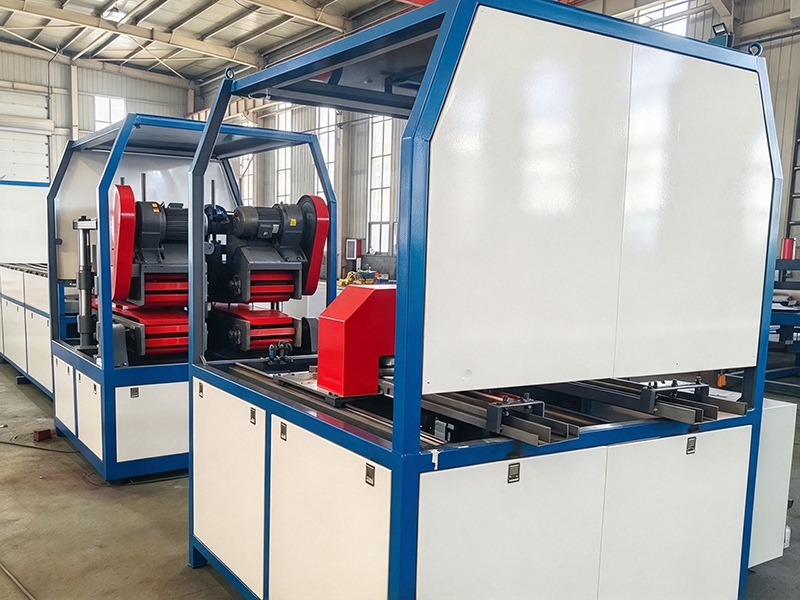
Fiberglass Rebar Equipment
Fiberglass rebar equipment for continuous threaded GFRP rebar production, with automatic haul-off, winding and cutting control and quick die changes....
Product Overview
Fiberglass rebar equipment is a dedicated complete set for producing fiberglass threaded rebar, made up of yarn paying-off, resin impregnation, forming, rib winding and haul-off cutting units. It produces fiberglass rebar with a threaded surface continuously and is core equipment for GFRP rebar manufacturers, whose product is widely used to supply reinforcement for engineering work. The process is mature, the machine runs steadily, the investment is reasonable and the return is dependable.
The equipment is highly automated and steadily produces fiberglass rebar of uniform diameter with regular threads; the rebar bonds well with concrete. By changing the die and the rib-forming mechanism it can produce a range of diameters, meeting diverse market demand flexibly, which makes it the practical choice for a company building a GFRP rebar line. Operation is simple, the control system is intuitive and production starts soon after installation.
Technical Parameters
The machine covers the diameter range commonly used for replacing steel rebar, and haul-off speed, winding speed and curing temperature are all controlled automatically. Dies and rib-forming mechanisms are supplied with the equipment and can be changed quickly to suit the required rebar diameter, meeting the needs of batch production across specifications. The units work in step: paying-off, impregnation, rib forming and haul-off cutting follow one another smoothly, so production runs continuously and steadily.
The control system is highly automated and allows key process parameters to be set and monitored, keeping rebar diameter uniform, threads regular and strength stable. Haul-off force and die configuration can be selected according to production scale, and the automatic cutting device performs cut-to-length cutting, which raises efficiency and yield. Energy consumption is reasonable and maintenance is easy; parameters can be adjusted flexibly to suit many rebar specifications.
Production and Quality
Every machine is assembled, commissioned and trial-run before delivery to confirm that all units work together reliably; after start-up, the mechanical properties of the product meet the requirements of structural engineering. Key components are made of quality materials, the structure is robust and maintenance is straightforward, which lowers long-term running costs. The company provides installation and commissioning, operator training and after-sales service to help customers start production quickly and run it steadily.
Component quality and overall machine accuracy are strictly controlled during manufacturing, so the equipment runs steadily and controls accurately. The company provides technical support to help customers tune process parameters and build production capacity quickly. Reliable operation and a low failure rate keep the line stable over the long term, and after-sales response is prompt, with spare parts and technical advice available to keep the equipment efficient.
Applications
Fiberglass rebar equipment is widely used to produce fiberglass rebar for building strengthening, bridges, tunnels, slope support and similar works. It suits manufacturers of composite rebar intended to replace steel rebar, where market prospects are broad and returns are steady; demand keeps growing and the range of applications keeps widening.
The fiberglass rebar produced on these machines can be used in all types of concrete structures, a broad field of application. The equipment helps companies raise rebar quality and output, meets the engineering market's demand for high-grade rebar and supports steady growth with sound economic returns.
Hebei Zhengche Trading Co., Ltd. provides equipment selection and technical consulting to help customers plan a GFRP rebar production base on a sound footing and invest efficiently.
The company also provides installation and commissioning and process training, so the line reaches production quickly and supports stable long-term operation.