

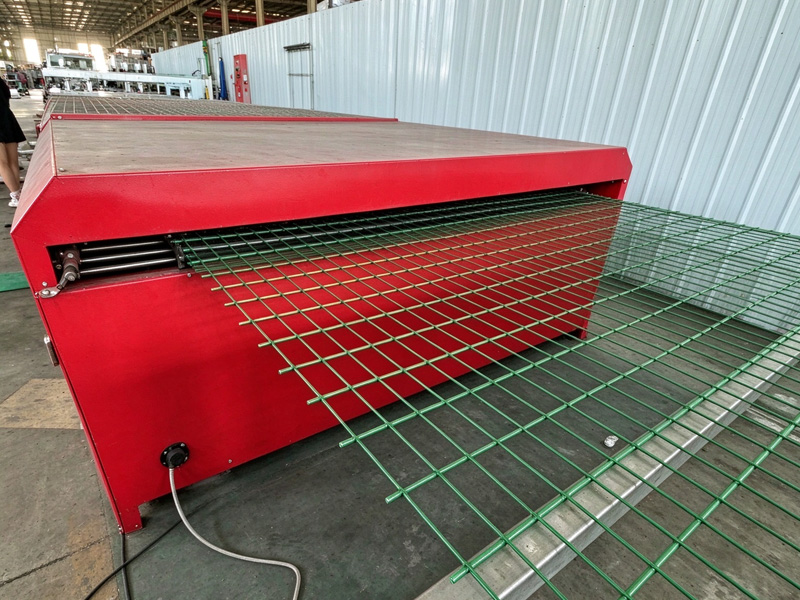
FRP Mesh Panel Machine
The FRP mesh panel machine lays longitudinal and transverse rebar at set spacing and fixes the crossings, forming a regular composite rebar mesh panel....
Product Overview
The FRP mesh panel machine is dedicated equipment for forming fiberglass rebar mesh panels. Longitudinal and transverse rebars are laid out at preset spacing and joined at the crossings to form a composite rebar mesh with a regular grid and even spacing. The machine can work alongside a rebar production line, completing continuous layout, fixing and delivery of panels, and it is the core unit for batch production of fiberglass rebar mesh. The frame is rigid and operation is continuous, accommodating panels in a range of specifications.
Construction and Components
The machine consists mainly of the frame bed, rebar guiding and laying mechanisms, longitudinal and transverse positioning devices, a fixing and joining mechanism, a haul-off roller conveyor and an electrical control cabinet. The frame provides the overall support and mounting datum; the guide mechanisms lead the rebars into their laying positions at the set spacing; the positioning devices keep the longitudinal and transverse bars square at the crossings; the fixing mechanism joins the intersections; the haul-off rollers carry the formed panel out continuously; and the control system coordinates the motion and running speed of each mechanism.
Forming Process
In production, rebars are fed into the machine in the longitudinal and transverse directions through the guide mechanisms and positioned at the set grid spacing. The crossings are joined and formed by the fixing mechanism, so the grid stays square and rebar spacing remains uniform. The finished panel is then delivered continuously by the haul-off roller conveyor and can be cut to length as required. By adjusting spacing, rebar specification and running speed, panels of different mesh sizes and widths can be produced.
Performance Features
Layout and positioning are accurate, giving panels with a uniform grid and firm crossing joints. Running is continuous and smooth, with haul-off and laying speeds kept in step, which suits batch production. Rebar specification and grid spacing can be adjusted to product requirements, so adaptability is good. Electrical operation is intuitive, parameter setting and product changeover are convenient, and routine maintenance centres on inspection and lubrication of the guiding, positioning and haul-off parts.
Applications
The machine is used mainly for producing fiberglass rebar mesh and composite material grid panels. Finished panels serve concrete reinforcement and structural strengthening in building floors, bridges and tunnels, slope protection and retaining walls, and municipal works. The machine can be linked with rebar production and surface treatment stages to form a complete mesh panel processing line.
Selection and Maintenance
When selecting a machine, panel width, grid spacing, rebar diameter, daily output and downstream cutting requirements determine the working width, laying mechanisms and haul-off configuration. In daily use, keep guide rails, guide wheels and haul-off rollers clean, check the positioning and fixing mechanisms at intervals, lubricate drive parts as specified and replace wear items, so that panel quality and long-term stable running are maintained.
In actual processing, the machine can be linked with unwinding, cutting and take-up stages to form a continuous mesh panel line. The manufacturer can recommend configurations and provide installation and commissioning guidance according to panel specification and output requirements, helping processors form composite rebar mesh of all types consistently.