

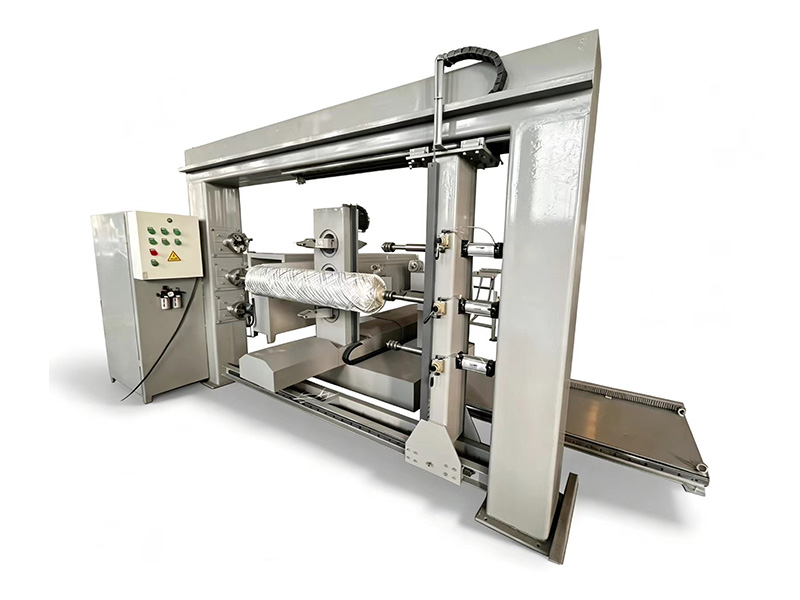
4D Winding Machine for FRP Pipes and Tanks
The 4D winding machine winds resin-impregnated fiber onto a mandrel at preset angles to form FRP pipes, tanks and profiles with even wall thickness....
Product Overview
The 4D winding machine is a filament winding system built for FRP and composite part production. By combining multi-directional fiber lay-up with controlled winding motion, it winds resin-impregnated fiber onto the mandrel at preset angles and, after curing, delivers pipes, tanks, profiles and similar products. Mechanical drive, electrical control and the winding process are integrated in one machine, so it runs continuously and forms parts consistently, making it one of the key machines composite producers use for batch manufacturing.
Structure and Components
The machine consists mainly of the frame and bed, the winding spindle, the travelling carriage, the guide eye and resin bath, the tension control unit, and the electrical cabinet with operator panel. The bed provides overall support and the guide rail datum; the spindle rotates the mandrel; the carriage travels along the bed to lay down fiber; the guide eye leads impregnated fiber along the programmed path; the tension unit controls how tightly the fiber is pulled; and the control system coordinates the speed and position of all moving parts.
Working Principle
In production, reinforcing fiber first passes through the resin bath to be impregnated, then the guide eye leads it onto the rotating mandrel. Spindle rotation and carriage travel are interlocked by the program, so the fiber is wound layer by layer at different angles to build a continuous, even fiber layer. By adjusting the winding angle, the number of layers and the fiber orientation, the hoop, longitudinal and multi-directional load-bearing performance of the part can be controlled to meet the strength design requirements of different products.
Performance Features
The machine lays fiber in multiple directions and offers a wide adjustment range of fiber angle, so it suits parts of different wall thickness and structure. Drive runs smoothly and the winding path repeats accurately, giving even wall thickness and a neat appearance. Electrical parameters can be set and stored according to process requirements, which keeps batch production consistent. The machine is compact in layout and convenient to operate and maintain day to day.
Suitable Products
This type of machine is used for the winding of FRP pipes, storage tanks, tank bodies, profiles and other composite bodies of revolution, and can serve production in chemical anti-corrosion, water supply and drainage, power and environmental protection fields. The specific product size and machine configuration are determined by mandrel dimensions, product length, wall thickness and output requirements.
Selection and Maintenance
When selecting a machine, consider the maximum product diameter, length, wall thickness, fiber type and expected output to define spindle specifications, carriage stroke and control system configuration. In daily use, keep the guide rails and transmission parts clean and lubricated, check the tension unit, guide eye and resin bath regularly, and replace wear parts according to the maintenance schedule to keep the machine running steadily over the long term.
FAQ and Operating Tips
Before starting the machine, confirm that the mandrel is firmly mounted and that the guide eye and guide rails are correctly positioned, then run the machine empty to check for jamming before going into production. During production, watch the resin pick-up and fiber tension to avoid uneven lay-up or dry fiber. After shutdown, clean residual resin from the resin bath and guide eye promptly, and lubricate the transmission parts on schedule to reduce the chance of faults and extend service life.